
Ancient Greek & Roman
Homer
Homer is the name tradition gives to the poet, or poets, credited with the Iliad and the Odyssey, the two foundational epics of ancient Greek literature. Nothing reliable is known of his life; ancient sources disagree even on his birthplace, and many scholars believe the poems as we have them are the culmination of centuries of oral epic tradition rather than the work of one man.
Whether historical individual or convenient legend, "Homer" is credited with shaping the Trojan War and the wanderings of Odysseus into the verse that became the bedrock of Greek and later Western literature and education.
This archive presents multiple English translations of the Iliad and the Odyssey side by side, so that the different choices each translator made — prose versus verse, plain diction versus ornate — can be compared directly. H. B. Cotterill's line-for-line translation of the Odyssey in English hexameters (1911) is among the Odysseys held here.
 Actual size
Before Homer
The Pylos Combat Agate
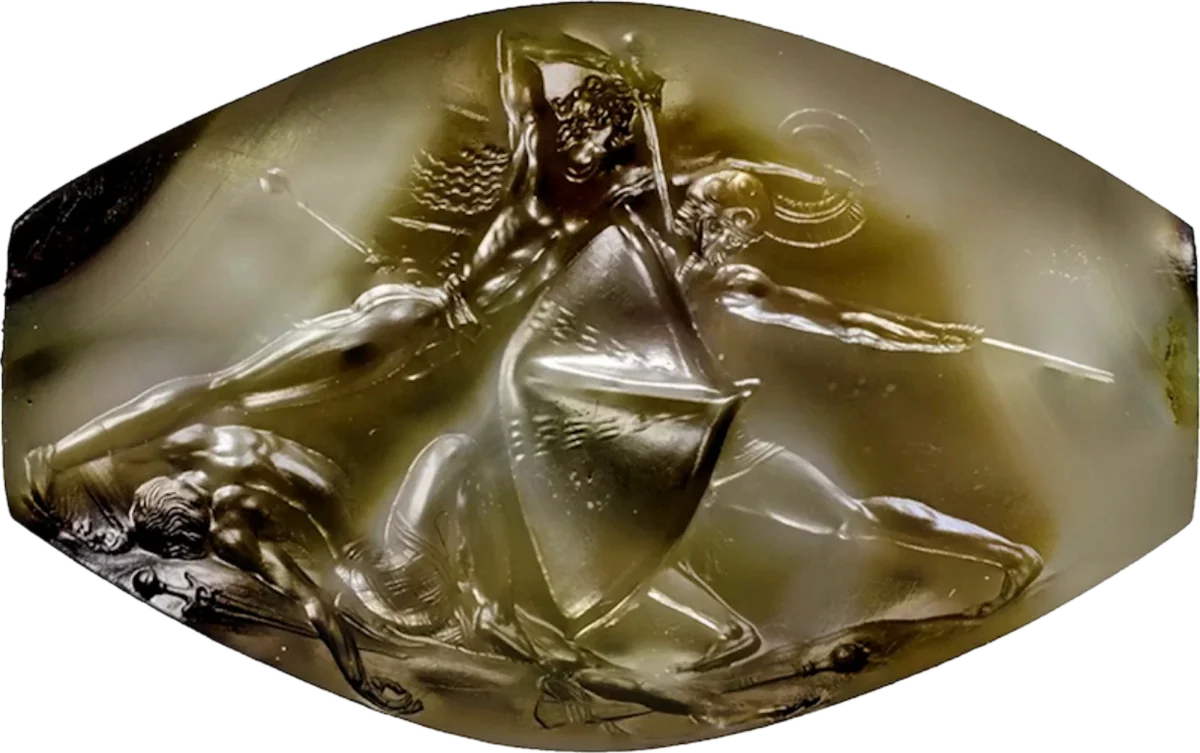
A warrior who has already struck down one enemy lunges over a great body-shield and drives his sword at the throat of a second, gripping the crest of the man’s helmet. The whole fight is cut into a sealstone smaller than a thumb, so finely that the muscles of the fighters and the patterns of their kilts can be read only under a lens.
It was buried with a man of rank, the so-called Griffin Warrior, beside the Palace of Nestor at Pylos, and found in 2015 by the University of Cincinnati excavation led by Sharon Stocker and Jack Davis. Encrusted with limestone, it was first taken for a bead; cleaning revealed the scene in 2017, and it is now counted the finest engraving known from the Aegean Bronze Age.
The Iliad would not be written down for another seven centuries, yet its world is already here: champions in single combat, crested helmets, the tall shields Homer still remembers in Ajax’s shield “like a tower”, and Pylos itself, the city of old Nestor.
Photograph: Palace of Nestor Excavations, Department of Classics, University of Cincinnati.
Major Works (22)
- The Homeric Hymns — translated by Hugh G. Evelyn-White (1914)
- The Homeric Hymns — translated by George Chapman (c. 1624)
- The Homeric Hymns — translated by Andrew Lang (1899)
- The Iliad — translated by Theodore Alois Buckley (1873 printing)
- The Iliad — translated by Samuel Butler (1898)
- The Iliad — translated by George Chapman (1611)
- The Iliad — translated by William Cowper (1791; Southey’s edition, New York 1860)
- The Iliad — translated by Edward, Earl of Derby (1864)
- The Iliad — translated by Thomas Hobbes (1676)
- The Iliad — translated by Andrew Lang, Walter Leaf and Ernest Myers (1911)
- The Iliad — translated by A. T. Murray (1924)
- The Iliad — translated by Alexander Pope (1715–1720)
- The Iliad (Way) — translated by Arthur S. Way (1886–88)
- The Odyssey — translated by S. H. Butcher and A. Lang (1879)
- The Odyssey — translated by Samuel Butler (1900)
- The Odyssey — translated by George Chapman (1614–15)
- The Odyssey — translated by H. B. Cotterill (1911)
- The Odyssey — translated by William Cowper (1791)
- The Odyssey — translated by William Morris (1887)
- The Odyssey — translated by A. T. Murray (1919)
- The Odyssey — translated by Alexander Pope, with William Broome and Elijah Fenton (1725–1726)
- The Odyssey (Way) — translated by Arthur S. Way (1904)
Poems (38)
- The Battle of Frogs and Mice
- Epigram I: To the Dwellers at Cyme
- Epigram II
- Epigram III
- Epigram IV
- Epigram V
- Epigram VI
- Epigram VII
- Epigram VIII
- Epigram IX
- Epigram X
- Epigram XI
- Epigram XII
- Epigram XIII
- Epigram XIV
- Epigram XV
- Epigram XVI
- Epigram XVII
- Book VII, 153: On Midas
- The Battle of the Frogs and Mice (Batrachomyomachia)
- To Cuma
- In his Return to Cuma
- Upon the Sepulchre of Midus Cut in Brass, in the Figure of a Virgin
- Cuma, refusing to eternize their State, Though Brought Thither by the Muses
- An Essay of his begun Iliads
- To Thestor’s Son inquisitive about the Causes of Things
- To Neptune
- To the City of Erythræa
- To Mariners
- The Pine
- To Glaucus, Who was so Miserably Sparing that he Feared All Men’s Access to Him
- Against the Samian Ministress or Nun
- Written on the Council Chamber
- The Furnace called in to sing by Potters
- Eiresione, or the Olive Branch
- To certain Fisher-Boys, pleasing him with Ingenious Riddles
- Iliad I (Dryden)
- Iliad VI: The Last Parting of Hector and Andromache (Dryden)